
https://www.indianheadproducts.farm/blog/without-indianhead-composting-solutions-your-poop-pollutes/
Without Indianhead Composting Solutions Your Poop Pollutes
- The inconvenient truth after the flush
- “Free fertilizer” or time‑release pollution bomb?
- The invisible hitchhiker: PFAS in biosolids
- The costliest “savings” you’ll ever see
- Florida’s rules: better than nothing—still not enough
- Storms are coming. So is runoff.
- Why disciplined composting is different
- Indianhead Composting: the game‑changer Florida needs
- What if every municipality implemented Indianhead Composting technologies?
- A practical blueprint for turning the tide
- FAQs
- Sources & further reading
Indianhead Farm Products is a steward of our community and environment. Every claim is anchored in publicly available science, regulations, and reporting. Links throughout allow you to verify the facts.
1) The inconvenient truth after the flush
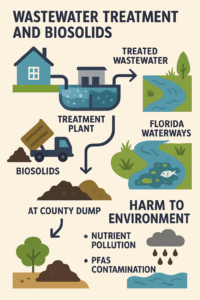
When you flush, wastewater travels to a treatment plant that does an excellent job on the water—removing solids, degrading organics, and disinfecting before discharge or reuse. But there’s a byproduct you don’t see: biosolids (sewage sludge), the concentrated solids that accumulate in the process. Florida’s Department of Environmental Protection (FDEP) explains that these solids build up in plants and must be removed; EPA defines how biosolids relate to sewage sludge and the regulatory framework for their use and disposal
(FDEP program page;
EPA biosolids basics).
Florida classifies biosolids by treatment level: Class B (minimum treatment), Class A (higher), and Class AA (highest, can be distributed/marketed like fertilizer). For years, a large share of Florida’s minimally treated Class B biosolids have been spread on agricultural lands under permit—especially in the Upper St. Johns River Basin (USJRB), after policy changes curtailed land application around Lake Okeechobee and the Northern Everglades and redirected sludge north
(St. Johns Riverkeeper;
Our Santa Fe River / The Invading Sea).
2) “Free fertilizer” or a time‑release pollution bomb?
Biosolids are rich in nutrients, but they’re an imbalanced fertilizer. Apply enough to meet a pasture’s nitrogen needs and you often overload phosphorus. Florida’s hydrology—flat terrain, high water tables, and intense rainfall—turns that excess into runoff. The St. Johns River Water Management District (SJRWMD) has reported ~9× higher phosphorus runoff from biosolids disposal farms compared to non‑biosolids sites and documented basin‑scale increases in phosphorus concentrations where land application occurs
(SJRWMD: Canion et al.;
SJRWMD: Dobberfuhl & Marzolf).
That runoff fuels harmful algal blooms, which strip oxygen from the water and trigger fish kills and ecosystem collapses—visible, gut‑punch symptoms of a hidden nutrient addiction. Worse, soils saturated with phosphorus exhibit legacy P: even if you stop applications today, they can bleed phosphorus for years to decades, delaying recovery long after the trucks are gone
(SJRWMD: Canion et al.;
WUFT: Sludge & the St. Johns).
3) The invisible hitchhiker: PFAS in biosolids
Enter the forever chemicals: PFAS (per‑ and polyfluoroalkyl substances). Wastewater plants aren’t designed to remove PFAS. These compounds tend to partition into solids; when those solids are land‑applied, PFAS can leach to groundwater, move with stormwater, and accumulate in crops and livestock—ultimately ending up in our bodies
(EPA basics;
Riverkeeper: PFAS & biosolids).
Here’s the chilling part: Florida does not routinely require PFAS testing for biosolids. Advocates across the state continue to press for testing and limits, especially as new federal PFAS drinking water standards come online and utilities anticipate more PFAS concentrating in sludge
(WUSF/CF Public Media;
Riverkeeper: PFAS).
The good news: innovators are moving. The City of Orlando is piloting supercritical water oxidation (SCWO) to destroy PFAS in sludge and reduce solids volume—proof that safer options exist and can scale with support
(EPA case study: Orlando SCWO;
FDEP overview).
4) The costliest “savings” you’ll ever see
Land‑applying Class B biosolids is “cheap” only if someone else pays the tab. Economists estimate at least $1.12 billion in potential cleanup costs tied to land‑applied biosolids in the Upper St. Johns River Basin over the next four decades—excluding PFAS liabilities and health impacts
(Jax Today;
The Invading Sea / 1000 Friends of Florida).
5) Florida’s rules: better than nothing—still not enough
Florida’s Rule 62‑640 governs biosolids classification, metals limits, site permitting, and nutrient management plans (NMPs). On paper, NMPs should control application rates. In practice, nitrogen‑based spreading still overloads phosphorus, especially on bahia pastures, and the rule
does not include PFAS testing or limits
(FDEP biosolids program;
WUFT: Sludge & the St. Johns).
Florida law also restricts land application where seasonal high water tables sit close to the surface—implicitly acknowledging the pathway to aquifers in our sandy soils
(F.S. 403.0855;
FDEP).
6) Storms are coming. So is runoff.
Florida’s climate is a stress test: tropical downpours turn fields into conveyor belts for nutrients and contaminants. SJRWMD field work shows phosphorus spikes from biosolids sites during storm events, while watershed data reveal concentration increases that track application intensity
(SJRWMD: Canion et al.;
SJRWMD: Dobberfuhl & Marzolf).
7) Why disciplined composting is different
Composting—done right—is not “spreading sludge by another name.” It’s a controlled, thermophilic process that reduces pathogens and stabilizes organic matter, producing a predictable product that can meet Class AA standards for distribution and marketing. The difference between compost and rotting sludge is simple: process discipline and proof
(EPA basics;
FDEP: Classes & uses).
Composting is not a magic wand for PFAS. That’s why a modern program pairs feedstock screening and third‑party testing with advanced destruction for problem sidestreams—preventing PFAS from being diluted into soils and food chains
(WUSF/CF Public Media;
EPA: Orlando SCWO).
8) Indianhead Composting: the game‑changer Florida needs
Imagine a Florida where every municipality stops land‑applying minimally treated sludge and partners with Indianhead Composting Solutions. That’s not a dream—it’s a blueprint for survival.
At https://www.indianheadproducts.farm/, we refuse the status quo. Our approach is built on four pillars:
- PFAS defense at the gate: rigorous feedstock control and Riverkeeper PFAS brief).
- Thermophilic precision: documented temperatures and retention to reduce pathogens, delivering Class AA‑quality outcomes
(FDEP classes). - Nutrient‑informed product design: engineered N‑P‑K ratios and slow‑release profiles to avoid phosphorus spikes and runoff
(EPA basics). - Transparency & accountability: batch‑level lab reports and public documentation—because trust must be earned
( send high‑risk sidestreams to PFAS‑destructive technologies like SCWO where warranted—compost what’s clean, destroy what’s not
(EPA: Orlando SCWO).
9) What if every municipality implemented Indianhead Composting technologies?
If Florida’s municipalities adopted Indianhead’s standards and technologies statewide, the transformation would be immediate and profound:
- Class B land application ends in sensitive watersheds like the Upper St. Johns, eliminating a major phosphorus source and cutting the fuel supply to harmful blooms
(SJRWMD: Canion et al.). - PFAS risk plummets thanks to feedstock screening, disclosure, and routing of hot‑spot streams to destruction technologies
(Riverkeeper PFAS;
EPA: Orlando SCWO). - Waterways recover faster as nutrient loading declines and soils begin to draw down legacy P instead of adding to it
(SJRWMD: Dobberfuhl & Marzolf). - Taxpayers save billions by avoiding the projected $1.12 B cleanup and long‑tail liabilities
(Jax Today).
In plain English: without Indianhead Composting, your poop pollutes. With it—and with municipal adoption—it nourishes soils safely.
10) A practical blueprint for turning the tide
- Declare biosolids‑sensitive areas: pause Class B land application in the USJRB and around headwaters like Blue Cypress Lake while PFAS testing and phosphorus controls are implemented
(WUFT). - Modernize Rule 62‑640: require PFAS testing/disclosure, phosphorus‑based caps and cumulative load limits, rainfall/water‑table “no apply” triggers
(FDEP;
F.S. 403.0855). - Fund an “all‑of‑the‑above” solids strategy: scale SCWO or equivalent for hot‑spot sidestreams; expand disciplined Class AA composting; create a public dashboard for volumes, testing, and destinations
(EPA: Orlando SCWO). - Choose responsible partners: work with testing/com
https://www.indianheadproducts.farm/contact/
11) FAQs
Are biosolids dumped into waterways?
No. Direct dumping is illegal. The problem is indirect: when sludge is spread on fields, Florida rains wash nutrients and contaminants into ditches, canals, and rivers
(Riverkeeper).Is landfilling a solution?
Landfilling can be an interim defensive move in sensitive watersheds, but it has trade‑offs (space, methane, leachate including PFAS). The real fix is to stop creating pollution pathways—screen inputs, compost responsibly, and destroy PFAS where needed
(EPA: Orlando SCWO).Does upgrading to Class AA solve everything?
Class AA improves pathogen and metals control, but PFAS requires separate attention. That’s why Indianhead couples Class AA composting with feedstock screening and advanced treatment for problem streams
(FDEP classes;
Riverkeeper PFAS).12) Sources & further reading
- Florida DEP — Domestic Wastewater Biosolids: Program & rules
- EPA — Basic Information about Biosolids: Overview
- SJRWMD — Canion et al. (slides): Biosolids‑derived phosphorus
- SJRWMD — Dobberfuhl & Marzolf (slides): Upper St. Johns lessons
- St. Johns Riverkeeper — Sewage Sludge in the St. Johns: Action alert & data
- St. Johns Riverkeeper — Biosolids & PFAS: Issue brief
- WUFT — Forever in Florida: Sludge & the St. Johns
- The Invading Sea / 1000 Friends of Florida: Statewide biosolids assessment
- Jax Today — Cleanup cost analysis: $1.12B estimate
- WUSF/CF Public Media — Call for PFAS testing: Coverage
- EPA Case Study — Orlando SCWO PFAS destruction: Pilot details
- Florida Statutes §403.0855 — Land application / groundwater: Text
Ready to stop the pollution pathway and protect Florida’s waters?
Talk toproducts.farm/services/composting/
|